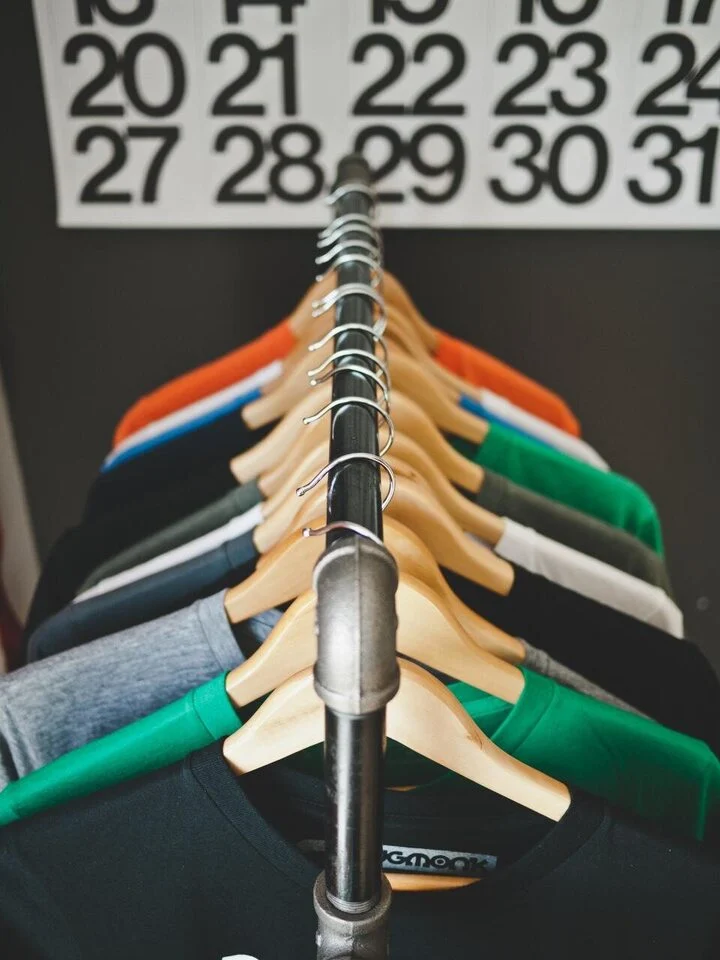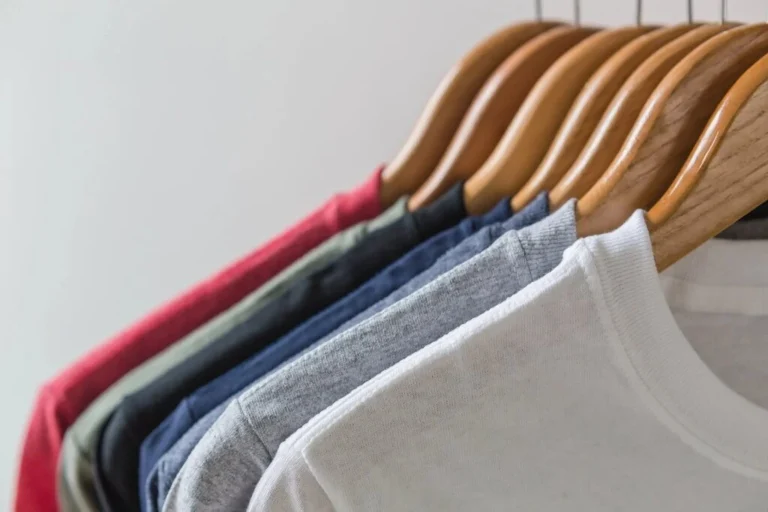
A great print on the wrong shirt feels cheap, and a plain design on the right shirt feels considered. Five choices decide how your tee turns out.
Fabric weight
Weight is measured in grams per square metre (gsm). Lightweight tees at 140 gsm are cool and drape well, which suits summer events and giveaways, but thin cloth can show through under a large print. Our everyday weight of 180 gsm is the safe default. Heavyweight tees at 220 gsm feel substantial, keep their shape after many washes and carry big prints without puckering. Hoodies use 280 gsm French terry.
Fit
Unisex tees run straight; women’s tees and tanks are about 1.5 in (4 cm) narrower. If the group is mixed, offer both cuts rather than guessing one. Check the chest widths on the size guide, because printed garments cannot be exchanged for size.
Neck and label
A ribbed crew neck stays flat after washing and is the most durable. A scratchy label annoys people, so the neck label option lets you choose a printed inside label instead of a sewn tag. It also gives you room for a small logo or care text.
Garment colour versus ink
White and light garments show every ink colour accurately. Dark garments need an underbase, a layer of white under the colour, so the design stays bright. DTG and DTF handle this automatically. In screen printing each colour, including the white underbase, adds a screen, so a four-colour design on black may need five.
Which method suits the shirt
- Cotton, light colour, photographic design: DTG.
- Dark garment with bright graphics, small run: DTF transfer.
- Blend or tri-blend with flat colours, 24 pieces or more: screen print.
- Left chest logo on a polo: embroidery.
A quick way to decide
Start with the person wearing it. A shirt for a day-long event needs soft, light cloth. A shirt for a crew that will wash it every week needs the heavyweight option. Then choose the colour, then the print method. Order one sample first if the group is large; a single DTG tee costs little and shows you the cloth, the fit and the print together.